Sunday, 12 April 2015

From whence he fell.


My brother and I have a strange sense of humour. Often, we get a little over excited and we let ourselves get carried away with silliness and things that are irrelevant and inconsequential. I was asked yesterday by a friend what my brother's job was. My reply was, "I don't know. We don't talk about those things much." We have, however, discussed in length our fantasy to join the Amish or start a farmstead in rural eastern Europe.

We find it hard to talk seriously, but we can do silly very well. This is often coupled with a sense of the macabre and morbid. This is a text message exchange which highlights it perfectly. My brother text me with this:
I've decided that if I die in a cliff accident I want a bench put at the top with the words, "from whence he fell".
From there, it descended into chaos (see what I did there- descended... oh, never mind). We sent each other a series of epitaphs appropriate for such a situation. Here were the results.

  1. His favourite view- and his last.
  2. Here's a bench, for your repose, where I was dashed on rocks below.
  3. May this seat support your weight, unlike the cliff did on that day.
  4. From this bench a view to see: where I fell into the sea. And as you look and catch your breath, consider how I gasped to death.
  5. And here is planted a small bush, to mark the place where he was pushed.
  6. This bench is a reminder showing, one should watch where they are going.
  7. Here's where I came to watch the tide; down below is where I died.
Have you got any of your own contributions? Which is your favourite?

Monday, 5 January 2015

Music Mondays: Western Film Tunes

Welcome to another sporadic and unfinished series: Music Mondays! This is where, on the odd Monday, I share some things about music I like and why I like them. It's going to be eclectic and it's going to be bizarre.

Western Film Tunes
The Western Film genre probably has some of the most exciting or memorable theme tunes. They often capture so much about the genre itself: the sweeping landscapes, the palpable tension or the beat of hooves on the dusty terrain. There are some particular traits of film music that run through it like a thread of spaghetti (see what I did there).

1. Sweeping melodies
Often, the melodies are broad, with long, sustained notes on strings. It seems to me that sometimes the shorter notes are just incidental: a way to get from one long note to another. Often, the notes are augmented to emphasises this. One of the most iconic examples of the sweeping string melody is The John Dunbar Theme from Dances With Wolves.


If it's not the string section then it's probably the resonating brass timbres that carry the tune. Sometimes, it's shared between the two. Either way, they're going to be heavily underscored with the brass and strings. Sometimes, they will forego the strings or brass for a more interesting solo instrument, such as Man with the Harmonica from Once Upon a Time in the West. I like this version, because you can see what instruments are being used. And yes, there is an electric guitar (which crops up more often than you think in Western music). Notice how the brass and the strings underscore the flowing harmonica melody.


2. Percussion
It's not just the strings and brass that get the action in this genre, the percussion is pretty busy too. The tunes often have a strong beat and a driving rhythm made by whacking a few instruments with sticks. Sometimes, the beats are almost militaristic in nature. I think there is not a percussion instrument missing from Western scores; you'll find timpani, cymbals, xylophones and glockenspiels, woodblocks and even a few rain-sticks and vibraslaps. See how many percussion instruments you notice from The Magnificent Seven Theme. And don't forget to listen for those strings and brass.


3. Antiphony (call and response)
The melodies often have a sort of question and answer quality to them. There'll be a short rising phrase (probably comprising of sustained notes, played on strings), followed by a short falling phrase (or vice versa). This helps create the sweeping, undulating melodies. Often, one of these phrases is repeated throughout, often as a leitmotif that not only reoccurs throughout the piece, but throughout the film.

One brilliant and fun example of this call and response is in the overture for The Hallelujah Trail. Most of the melodies are made of up of short, repeating themes that are interspersed by a response. This is emphasised in sections when the call is made by one instrument, and it is responded to by another (which are, you've guessed it, brass and strings). But this structure becomes really evident just after half-way in. First, it is marked by a really interesting choice in percussion: clapping. Then the vocals kick in, with a call and response song, switching between male and female voices, and the whole choir together. It definitely has a marching-song quality to it. It's nigh impossible not enjoy the rousing tunes of this theme.


Now, I've put off including this tune for long enough. It has a bit of everything. The sweeping tunes, the percussion and the really, really famous leitmotif. It perfectly exemplifies the Western film tune. Oh, and it even has an electric guitar for good measure.


The famous two note leitmotif reoccurs throughout the piece and the film. It is used for the three main characters, but played on different instruments: flute, arghilophono (a type of ocarina) and vocals. These are shared throughout, it a call and response manner. It has a driving beat that begins on the timpani and goes through the whole percussion section. It even has brass and strings. You can't really get much better than this. This is why Sergio Leone is considered the quintessential Western film composer.

What's your favourite film music?
What do you think makes the perfect Western film?
Which examples have I forgotten?

Tuesday, 23 December 2014

Another sneak peak into my notebooks...

Sometimes, I'm a bit of a bumbling idiot. I get myself into ridiculous problems or get anxious about the silliest things. As a result, I have learnt a few things that can help get you through the crazy world we live in.

So, as I often find myself with an inexplicable feeling of deja vu, only to realise that I have been in this situation before and I have still yet to learn from my mistakes, I decided to write some of these down. When my niece turns an appropriate age, I shall give her the little brown notebook with my life lessons in: Uncle Tom's Maxim's.

Some of them are serious lessons learnt from painful mistakes. Others are helpful practical tips. Some of them are to add a little mischief or humour into life. Here are four examples.

Lesson #8
Choose what you are for not what you are against.

Lesson #9
You can boil eggs in a coffee maker.

Lesson #11
If it won't matter in a week, it's not worth worrying over.

Lesson #17
Try to pull silly faces in public without getting caught.

As you can see, some of them are borrowed and paraphrased from far wiser people (like Martin Luther King). Currently, there's only seventeen. Hopefully, by the time my niece is of a respectable age, there'll be a few more.

What advice would you give someone?

Tuesday, 16 December 2014

A sneak peak into my notebooks...

I have dozens of notebooks; they each have different purposes. Some of them are filled, some of them are empty, some of them have had their role replaced by other notebooks, some are testaments to eagerly embarked on hobbies. Usually, no one ever gets to see inside them. But think yourself lucky...

I have a favourite notebook. It is woefully underused, but it brings a smile to my face when I open it and when I read what is written in it. It's just a jotting of thoughts and moments. I went through a phase of writing things down that I saw, thought of or felt. I did it sometimes on my phone; a lot of those have been lost through technical glitches (rue you, Evernote!).

I thought I'd give you a sneak preview into some of the moments captured.

"What do you have planned for the weekend?"
"Not much," I replied, concentrating on not mounting the curb, especially as I couldn't rely on him using his duel control. "Just homework and stuff."
"You need to get out more," he said with a strange earnestness. "You can't just work all your life."
I didn't need want his advice. I didn't need saving from my boring existence. And definitely not by a driving instructor who stared vacuously out of the passenger seat window while biting his nails.

In my previous job, I would often catch the train to work and would have to wait at various stations. This is where I collected most of the moments in this notebook.

The lady behind the counter greeted each customer as though they had just arrived at her birthday party.
"Hello!" she'd cry while she flung her arms into the air. "What can I get you today?"
She would tempt you with the offers as if she was showing you the buffet table: muffins, croissants and a you-know-you-want-to smile.

I'm especially fascinated by glimpses into worlds that I'm not usually a part of. It's like peeking through a keyhole in a locked and mysterious door. There were two builders at the train station one day that caught my attention.

"We'd never get a one point two in there," he said, waving his hands at the ceiling. "And what about the trunking? Fifty by fifty, you think?"
His companion mumbled an answer, gazing at wherever the louder man waved.
"It's getting the fixing for it," he said with a finality as if he solved all life's unanswered questions. "That's going to be the problem."

There are always some unusual characters at the train station (it's usually the guy with the little black notebook, writing down other people's conversations. Say hi, it's only me).

In the midst of the modern passenger and their accessories- bright pink trundle cases, high heels, canvas satchel bags and grey coats- was a man oddly out of place. He was wearing plus-fours, thigh high socks, loafers and a tweed flat-cap. If wasn't for the absence of a gun, he may have been off for a spot of grouse shooting.

This may be a New Year's resolution for 2015: fill the notebook. I hope this has given a little insight into the inside of my mind and how I see the world. Okay, one last one.

What I hate most about being thrust into a group of people I don't know is the utter drivel people talk. I am talking drivel, the person next to me is talking drivel and the excitable woman in the corner is most certainly talking drivel. At least I have an awareness of what nonsense I am speaking. Others do not. That woman is spouting it with such fluency she must have practiced it as one does a foreign language: with tedious repetition.

Sunday, 9 November 2014

Pop Sonnets

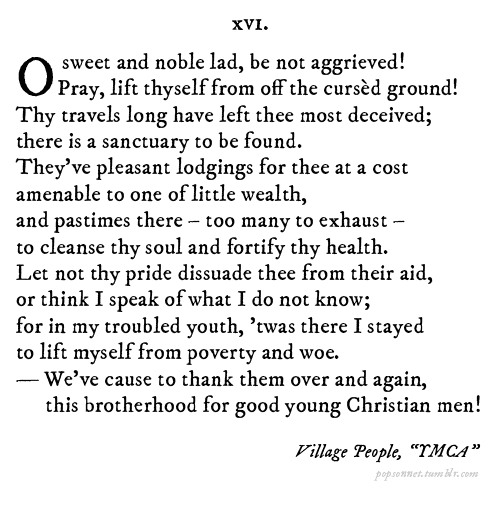
Pop sonnets are one of the most ingenius things I have ever seen (closely rivalled by Mr Men reviews, which will be reviewed themselves next week). The idea is simple, but it's execution is perfect. The writer takes contemporary pop songs and turn them into Shakespearean sonnets. Complete with iambic pentameter, archaic words and pronouns, they seem to be taken out of the early 1600s.


Perhaps, before we consider what a masterpiece these witty poems are, we should consider the significance of the sonnet form itself.

A sonnet is an Italian form of poetry, that has been popular across Europe and has been used in many different contexts. There are various different types of sonnets, which have been modified through history for different purposes. The simple basics about sonnets are that they have fourteen lines (unless it's Sonnet 99 and 126 by Shakespeare) and they rhyme.

Originally, the sonnets had a problem/resolution form. Basically, there were two ideas that were linked. The first eight lines would have the first idea, and the remaining six lines stated the second idea. This change of ideas (called the volta) would be marked by a change of rhyme scheme. The first eight lines would have two sets of an a-b-b-a pattern. There were a number of ways the last six lines could go; commonly it would go c-d-e, c-d-e or c-d-c-c-d-c. There were other ways you could do it, but you would never end with a rhyming couplets- for some reason Italians didn't like it. These sonnets are called Italian or Petrarchian sonnets (after Petrarch, the guy that did not come up with them- that was Giacomo di Lentini).

However, English sonnets were different. The idea of the sonnet reached English shores a lot later and in the form of translation. They still had fourteen lines, they still rhymed, but were, perhaps, simpler in their execution. They generally consisted of an alternating rhyme scheme for the first twelve lines (a-b-a-b, c-d-c-d, e-f-e-f), completing on a rhyming couplet (Petrarch would be outraged!). Again, the English sonnet would have a thematic shift in the ninth line (the volta). Shakespeare, the saucy rascal, however, would usually leave the volta until the thirteen line, and the couplet would show the second idea or a summing up of the poem as a whole.

Shakespeare is perhaps the most famous sonneteer in the English language. He wrote 154 of them, as well as some making up the lines of his play. The scene where Romeo and Juliet meet consist of a perfectly balanced sonnet. Romeo holds the first quatrain (first four lines), Juliet speaks the next, complementing his religious language and metaphors with those of her own. The third quatrain is divided between them, and they each share a line of the finishing couplet (finishing with "purged").


How beautiful.

Henceforth, the sonnet form is used throughout literature until the present day (although it did fall out of fashion for a little bit before Wordsworth, à la Timberlake, decided I'm bringing sonnets back). Wilfred Owen used the form in, perhaps in a somewhat ironic fashion, his Anthem for Doomed Youth. The form is often reserved for themes of love, but this time it is used to describe the loss of thousands of young men during the fighting of World War I. It could symbolise the love he had for his fellow comrades, but the ironic reading fits in with the use of the celebratory and patriotic word 'anthem' in the poem's title.

Now, the time-honoured tradition of sonnets is being celebrated by this wonderful, wonderful person who invented the pop sonnet. It's purely Shakespearean in style (alternative rhyme, volta towards the end in the rhyming couplet, iambic pentameter), and they are so perfect they could almost be genuine. There are currently thirty two of them, but new ones are released each Thursday. Go check them out.

Sunday, 26 October 2014

Itchen Way and Navigation

At risk of being a stuck record (people still know what they are, right?), I am an introvert, so tend to do introverty things. This includes going on long walks on my own. Okay, it wasn't actually that long distance-wise, but it took a long time because I really wanted to notice everything. I wanted to enjoy the sights of autumn, savour them and record them for me to enjoy later. (Also, I ended up chasing a pheasant half-way to Winchester, but more on that later).

I am so fortunate to live where I do. I live in a city with many amenities on my door-step. I am a ten minute (or less) walk away from a train-station, a co-op, two ice-cream parlours, a sweet-shop, a bakery, a butcher's, three pubs in the Good Pub Guide, really good Indian restaurants, a really good pizza parlour, some really good chippies and Sainsbury's. I'm also very close to some really nice parks, and within a twenty minute walk I'm basically in countryside.

That's where I headed today. The Itchen Navigation runs along an old canal route, between Southampton and Winchester. It passes through a Natural Conservation area, the Itchen Valley. I headed to my local Co-op and bakery for fuel (a bacon and cheese pastry wrap and a bottle of Pepsi), as I embarked on my adventures.

I really loved the colours of autumn in Riverside Park. The sky was bright blue, and the leaves are turning into their delicious golds, red, and greens. At the end of Riverside Park, there is a row of maples (maybe sycamores) that are ablaze with reds and oranges.

Riverside Park

Ducks!

At the end of the park, you come to Mans Bridge, which has had a bridge at that site since the 900s. It used to be the southern most crossing of the River Itchen. Here you walk up towards the Itchen Way, which is the old tow path along the Itchen Navigation (a series of canals that run the course of the Itchen River). Just before getting to the tow path, I met this little critter.


The Itchen Navigation still has evidence of locks along it, including these 300-year-old walls, that would have supported the lock gates.


Along the way, I met another little critter, this time a dragonfly (I think it was a common darter).

We even became friends.


I was amazed by the array of colours that I saw on my walk. Yellow...
Purple...
Pink...
Red...

Sometimes, all together.
After a while, I decided to head back. Then I spotted something: a flash of shimmering green, a pearly band and russet. It was a pheasant. I became determined to get a photo of him. So I chased, the little rotter a mile up the Itchen Way. I stalked him through crackling leaves, straddled muddy slopes and slunk through nettles. This was the best photo I got. The bird then got away.

However, the chase did lead me past some interesting sights (including the berries above).


It's these sights and scenes that make autumn such a special time for me. The variety of colours and the strange quality of the light make everything magical. It's the last burst of life before winter.
There were some things that I didn't get a photo of such as a dog that looked just like a red panda and a woman picking her nose at the play park. Oh, and a close up of that ruddy pheasant.

Instagram

Saturday, 25 October 2014

Life after school

I often find myself, as the average teacher, bemoaning the loss of life my profession brings. The heavy workload, the parents' evening, the exhaustion leads to few opportunities for culture or enjoyment. There's probably a sermon about appreciating what you have and living in the moment in there somewhere. But this isn't the post for that. This is a post of celebration and good news, not of didacticism and moralising. This week...I've had a life! (Hold the press! Front cover scoop!)

Last Saturday, I went to see a performance of Othello at the Nuffield. Admittedly, it was with students, but it was with the sort of students that you just tick off the register to say they're there and you can leave them to their own devices. The production company was called Frantic Assembly, and they try to take plays and make them modern and accessible. They mostly do this through rich, sharp, choreographed sections; grimy sets and modern music.


Steven Miller (who is of Casualty fame - if there is such a thing) played Iago brilliantly. He was sleazy and serpentine, evoking Edenic temptations. The actor who played Othello was not as nuanced, perhaps as a result of his excessively tight trousers. Overall, it was really good and the kids loved it.

Then, Tuesday evening, I went to see another theatre production: Wicked. I saw it in the Mayflower, Southampton. It's the first time I've seen it, but according to my friend who's seen it about eight times, it is a good as in the London theatres. I was also impressed by the friendliness of the staff at the Mayflower. We arrived with about a minute to go, where they greeted us at the door: "Are you Tom and Liz? We have your tickets." Then they showed us to our seats, smiling as they went. The staff at the merchandise stall were chatty and enthusiastic about the products they sold.

Ashleigh Gray as Elphaba, from the Basingstoke Gazette.

The musical itself was fantastic. The story is witty and somewhat moving, with good musical numbers and interesting characters. The lead actors, Ashleigh Gray and Emily Tierney, were amazing in their roles as Elphaba and Glinda the good. The set design was awesome. It was just really good.

Obviously, being a teacher and all, two things in one week is going to be enough. There can't be anymore, right? Wrong! On Wednesday, I went out yet again. This time it was to a pub, not the theatre. It was a friend's birthday/ get together with old PGCE buddies. We went to the Rockstone. The intention was to go to Marshal's but the oven wasn't working, so we got sent to their sister establishment with 20% off. The Rockstone is renowned for its hefty burgers and massive portions. We spoke hilarious rubbish, laughed a lot and I told my classic, grim and somewhat inappropriate anecdote (that I'm saving for my memoirs).

So that was it, surely that was enough culture and socialising for one week. That's what I thought too. But a friend was planning to see Mark Thomas with her dad. Unfortunately, her dad wasn't able to go so I was asked to go instead. 

Mark Thomas is a comedian, political activist and a domestic extremist. Apparently, he has an apron with 'domestic extremist' cross-stitched into it. The first half was his political ramblings and jokes. Highlights include his comment about the pronunciation of the name of UKIP's leader's surname and giving it a definition. The second half was the Amnesty Freedom of Expression Award winning monologue, play or retelling of Mark's life as a political activist. The content ranged from exposing the illegal activities of arms dealers to tales of friendship and betrayal. It was well done, funny and poignant.

Now, that is is. I promise. Otherwise it's going to end up as a visit Southampton advert. There's only so much fun boring teachers are allowed to have.

Saturday, 18 October 2014

A lotta allotments

Autumn is here; the weather is getting wet and cold. So, what's the perfect activity for this time of year? Gardening, apparently.

Last Saturday, a group of us from church went to help out on a friend's allotment. Their circumstances this year have not been conducive to keeping on top of weeding, etc. So in preparation for next year, we turned over her beds so the are ready to be planted in. Hopefully, it'll mean just a bit of weeding (although she has bindweed and dandelions a-plenty) and she is all ready to go.

We had a few occasional showers, but the sun was bright for the most part. It was particularly nice during lunch.


I've also got myself a more permanent allotment fix. Another friend has one local to me and I'm going to be helping out on theirs (I just need a key). This plot comes complete with a mud hut. So my winter is going to be spent digging and seeking refuge in the hut. I might buy a wood burner for it.

I'll return with photos over the year.

Monday, 6 October 2014

I'm the King of the Castle

My school has a staff and student book club. Up until now I've got away with not reading anything; they've all been books I've already read. However, I decided I would actually, you know, read a book for a book club.


The book I ended up reading was I'm the King of the Castle by Susan Hill. It features a young sociopath, a well-meaning dad, a feckless and foolish mother and a boy called Charles Kingshaw who has to negotiate all this. For the most part, nothing much really happens. There are a few childhood scraps, Kingshaw gets attacked by a crow, Kingshaw attempts to run away, there is an accident at a castle. But that's probably the beauty of it. It's a simple plot that is woven in beautiful description and insightful narratives from the characters' minds. The settings are so crafted with detail and precision; the characters are developed and nuanced.

Furthermore, the simplicity of the storyline allows the ideas of the claustrophobic house, the fight for power between the boys, loss and injustice to explored in depth. It meant that readers are able to sense the struggles and the pain that Kingshaw feels and they understand it fully. As a result, I found it impossible not to be drawn and relate to this world of an eleven-year-old boy. I was surprised at how emotionally involved I got when reading it.

It is the first time that I truly resented a character. It wasn't the sociopathic and chilling Hooper that I hated, but Kingshaw's mother. Everything she did was to the detriment of her child. I found myself getting so frustrated with her, just as Kingshaw did. I'm the King of the Castle ends rather tragically, and I was glad for it. There was a sense of relief, but I also felt Helena Kingshaw deserved it. That stupid woman deserved every grief thrown upon her. I can't remember when a book brought out such a nasty side of me.

So, perhaps it's not a sweeping tale on a grand scale or a biting social commentary, but it was a pretty good read.

Sunday, 5 October 2014

Can't stop... Zombie hordes

So, I've recently got my first iPhone. I knew this day would come eventually, but I put it off for as long as I could. Finally, I relented and succumbed to the worldly desires that rage within me. My lust for shiny tech has won.

One of the selling points was the range of apps. I've just bought 'Zombies, Run!' (I know, I'm chasing behind that bandwagon too) and it's pretty fun. It's a basic concept: it's a fitness app with a post-apocalypse game thrown in. If, like me, you have little intrinsic motivation, it can be a great way to get you going. There's nothing like the words "Zombies approaching... Run!" to help you get your sprint on. If you're not up for having to add sudden bursts of speed to your run, you can turn the chase mode off.

So, if you see me running with a blind look of panic, there's probably an undead horde nearby. Just another normal day...

Saturday, 4 October 2014

The Not Quite There

This was a poem I wrote last year to commemorate my first half-term as an NQT teacher. When my mother was shown this, she thought it was written by Michael Rosen. I'm pretty sure it wasn't.

The Not Quite There

The Not Quite There can be seen from a mile,
With deep dark bags and a faltering smile;
And they're clutching at coffee with quivering hands
Whilst frantically looking for long term plans.
What's the first unit? And how long for?
Where are the levels for key stage four?
Who are my EALs, SENs and PPs?
And where is the list of all my tutees?

It's the fourth of September; school has just started,
But comes an announcement that makes them fainthearted.
The office that deals with qualifications
Has waited until the last day of vacation
To tell them the news that ruins their plans.
And behind this news is an odd looking man:
Like a pig in a wig with sticky-out ears,
And a big bulbous head full of silly ideas;
And a big bottom lip and a Thunderbird's chin;
And small beady eyes filled with evil and sin.

So the pig-like man said from his puppet-like jaw,
"The Speaking and Listening shall be no more!
For those poor children whose writing is weak,
But have good ideas when given to speak,
Should be, in my judgement, seen but not heard."
Which, I might add, is quite frankly absurd.

Scrapping work that had been completed?
The poor students would clearly feel cheated!
But teachers then thought of a genius plan,
And entered the kids in November's exam.
This early submission would surely secure
The marks the poor students had done the work for.
So reassured by this hopeful belief,
The teachers all sighed a sigh of relief.

But the pig in the wig with sticky-out ears
And a big bulbous head had other ideas.
With a menacing grin the pigman said
(raising his brows to the top of his head),
"From now on league tables will purely be set
By the first grades the children collect.
Requesting fresh chances is far too bold;
This country has standards that it must uphold!"

The Not Quite There heard the confusing new news,
And waited to see which path they would choose:
Would the poor kids be withdrawn from exams,
Or would the school keep to the original plans?
The staff were all thrown into a blind panic;
The Head was becoming completely frantic.
A Governors' meeting was quickly convened,
To think how to respond to that pigheaded fiend.

The submissions will stay! The exams will be taken!
And, although the staff were considerably shaken,
A decision was made and this cheered them on,
What else at this juncture could go possibly wrong?
The Mocks! That's what could go possibly wrong.
For, when the papers were looked upon,
The grammar was grim and the spelling was dire
The department had found themselves stuck in a mire.
The exam was too soon! Was it too late
To turn the tide? The ask was too great.

Extra sessions were scheduled. Targets were set.
Papers were practiced so they would not forget,
The skills that they needed to pass the exam.
Staff taught the students like battering rams,
Repeating advice, "Use capital letters!
And winsome words to make your work better!
And use an ellipsis and paragraphs too."
The answers improved and confidence grew.

And, although this was good, the work was not done.
Targets were set, extra session were run,
Papers were practiced and then given marks.
This was all quite a formidable task.
The teachers were white-washed, completely expended,
Dead on their feet when the half-term had ended.

Was it enough? Well, we'll just have to wait!
The exam is after they return from their break.
But at least you have been able to see,
What the first eight weeks were like for the poor NQT.

How to be an introvert...

Two years ago, I blogged about introversion and extroversion. I went into what my Myers-Briggs type indicator was. Now, let's get into some technical details about MBTI. There are a lot of criticisms about the whole system that raise questions about its validity. First, it relies of the self-reporting of the subject. The subject has to answer questions about themselves and if you want an honest appraisal of someone- never ask them! It can effect the accuracy of results. Extroversion, for instance, is valued in western culture, so subjects may answer questions to show a preference for this type indicator regardless as to whether they have a preference to it or not.

Another issue with MBTI is that no one is ever a perfect type. The system relies on four dichotomies, and for it to be a reliable personality indicator, the subjects should fall at the extreme ends of the scale. However, people do not. People's results tend to gather somewhere in the middle of the scale, making the effects of the types negligible. It becomes untenable to say that this person is definitely and ESFJ, or whatever.

Thirdly, people and situations change. Things that you enjoyed may not be the same in a couple of years. As a result of this and all these factors, it is exceptionally common for people's MBTI scores to change after a few years, or even months. Two years ago, my result was an ENFJ (Extrovert, Intuition, Feeler, Judge). Yesterday, it came up as ISFJ. So, apparently, I'm now an introvert. That makes quite a bit of sense to me.

So, the question is, what is it about me that makes me an introvert? This is a guide on how to be more like me: exceptionally socially awkward.

Think, "Why are you ruining this?"
This is what goes through my mind  when someone says, "We should invite so-and-so as well." I obviously say, "Great idea! More the merrier!" I'm actually thinking, "If I wanted them there I would have invited them already." Introverts tend to socialise in small intimate settings, and large groups can be exhausting. Therefore, we can be a bit select about who we invite.

Also, we often have to plan or mentally prepare ourselves for the interactions we're about to face. So, having that one extra person come along might not seem a big deal, but I often find it really throws me.

Be sad when you hear other people's music
I don't like to hear other people's music. Whether it is from a car passing down the road, a neighbour with a load sound system or a friend adding ambience to a meal, other people's music can add stress. It's not because I think they have bad taste. Introverts value quiet and limit the amount of stimulation they get. It's a bit like being shouted at; it can be a bit invasive to personal space. Ironically, a way that introverts sometimes isolate themselves from the outside world is through turning the music up. (I have been known to hide in my car, with my CD player on to get away from the world.) As a side note, I also hate adverts and radio DJs interrupting my listening. And I hate people shouting at the television when they're watching football. Loud laughs are pretty irritating. Too much noise, people, too much noise.

Don't like sharing news
I'm generally pretty open, but there are some occasions that I can suddenly and unexpectedly be reticent to tell others things. This can be due to various factors: tiredness, stress and the type of news it is. Only a few select people know when I'm dating someone. I hate the questions that come with this type of news and all the interest it cultivates. I will limit the information I give and I will probably not tell you the girl's name. Introverts tend to be quite private.

Now, when introverts do share things with you, don't congratulate them. I've sometimes had people say, "Well done for being open." I am quite articulate; I am fully able to let people know how I am feeling. Sometimes, I just choose not to. On the rare occasion I choose to, don't patronise me, otherwise it won't happen again. I will let you know the important things, but in my own time and on my own terms. Don't force it. And don't make a big song and dance about it either. That's exactly what introverts try to avoid.

Feel claustrophobic
If I'm ever stuck in a group of people with no way out (like in the middle of a row of seats against a wall in a restaurant), I can feel trapped and claustrophobic. I have to make an effort to distract myself from the fact that I CAN'T GET OUT AND I'M GOING TO DIE HERE. Social situations are exhausting, not being able to leave a social situation is terrifying. If you ever notice me fidget, take deep breaths or start counting backwards under my breath, I'm feeling penned in. To overcome this, I often have an escape plan...

Hide in the kitchen
I often tell my friends a particularly crafty lie. I tell them that I love washing up. I claim that scrubbing greasy pans and handling other people's half-eaten food gives me more pleasure than anything else in this world. Despite the absurdity of it, they believe me (or are more than happy to go along with it as they end up with clean dishes). And why do I do it? It's the escape plan. If sitting in the living room with everyone else has been too much, I sneak into the kitchen and start tidying. I can be safe in the knowledge that I will be undisturbed by everyone else. I just have to hope that another introvert hasn't beaten me to it.

Get lost on solitary walks
I often seek out the quietest spots I know. I'm not going to tell you where they are, that'd be stupid. I don't want to go there only to find you hanging around. In my effort to be alone, I will change course if I hear other people coming. This has got me lost a couple of times, when I've totally disorientated myself by people-dodging.

Be confident
This is one that is not quite to do with introversion, more to do with addressing a misconception about introverts. Introverts are not (necessarily) shy and their introversion is not a result of low self-esteem. I can happily talk to strangers, address groups of people and speak in front of crowds. I daily put myself in front of classes and subject myself to scrutiny, humiliation and confrontation. I am not shy. I just need to hide in a dark, quiet place for a while after any social interaction.

Get over yourself
Yes, I can be grumpy around people; I can get frustrated or annoyed quickly when social situations feel out of control. However, often I try to hide my feelings or I just accept they're my problem and not those around me. But if I am ever grumpy, and you're not sure why, it's probably because the social situation I'm in is causing me stress or just wearing me out.

Monday, 10 September 2012

Black Jesus

One of the great things about having a Kindle is the Daily Kindle Delivers Deals. This is where a book costs 99p for a 24 hour period. Not only do I like it because it's cheap, but it encourages me to read outside my usual pick of classic literature.

Black Jesus by Simone Felice was one of the ones I bought because it was on offer. The blurb on the website told me it was about a Marine, nicknamed Black Jesus, who has just come back injured from Afghanistan and an unusual dancer who is running away from an abusive boyfriend.


It's a bit of a clichéd salvation romance story, where two isolated and troubled people come together and release each other from their situations. Gloria, the ballet dancer who has had her dreams ruined, flees across an American landscape on the back of a Vespa scooter and finds the junk shop that Black Jesus' mum owns. She comes in and allows blind Black Jesus to have a transcendent moment that allows him to realise that he's always been metaphorically blind and now he has Gloria and can see in a metaphorical but-he's-still-actually-blind sort of sense. It's a little bit twee and suggests that disability, drug dependency and post-traumatic stress disorder can all be solved by a kiss at a creek.

The characters are two dimensional and predictable. Black Jesus is the standard survivor-soldier, who is troubled by what he's seen at war and this can only be solved by drugs or woman; Gloria, the key to salvation and the innocent and hopeful victim; Ross the abusive and controlling boyfriend who has a bizarre mental breakdown. There are a few cameos from music loving transvestites; recorder-playing, drug-abusing hippies and trash-talking drunks to give an 'edgy' reflection of modern American society.

Simone Felice is also a song-writer and this is evident in his writing style. Music and lyrics are a major theme of the book; but it's his metaphors that give the game away. They are short, they sound good, but when you take time to consider them they don't actually mean anything. There were a few passages where I was left wondering what he was going on about. Another thing that annoyed me was a lack of consistency. The narrative was third person but would often slip into the stream of consciousness of one of the characters. This is fine. Virginia Woolf does it, and she does it well. Simone Felice does not. Sometimes the shift is unannounced and confusing, sometimes it's shown by italics, which is also used for lyrics or announcements coming from the radio, or quotation marks. Pick one and stick with it.

Despite all this moaning, I didn't start the book with high expectations, so I wasn't disappointed. It was an easy read, it was fine for a commuting book and I don't miss the 99p I paid for it.

Monday, 3 September 2012

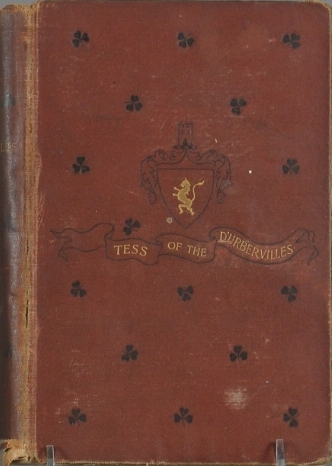
Tess of the d'Urbervilles


Having recently read Wuthering Heights, which is often heralded as a passionate triumph, and being somewhat disappointed, I was worried the same would happen when reading Tess of the d'Urbervilles by Thomas Hardy. However, Tess of the d'Urbervilles was brilliant. It was full of tragedy, tension and beautiful, descriptive writing. Even though there are many events that are deeply tragic and terrible, they are subtly and sensitively written.

Spoiler Warning!

Tess is a brilliant, virtuous character, the archetype of rural innocence. Although she may be seen as too-good-to-be-true and therefore an unrealistic portrayal of femininity, I think the way Hardy portrays her allows her to be both believable and loveable. Despite her constant pursuit of honesty and integrity, she constantly has to struggle against the evils of this world until her simple soul is finally and desperately crushed. You know from the offset she wasn't made for this world.

Alec d'Urberville may be the obvious villain of the story but some find Angel Clare a more detestable figure. It could be that Angel Clare was, at first, a potential source of happiness and hope for the wronged Tess, but he desperately lets her down. Also, Angel Clare never really has to suffer for his actions; Alec d'Urverville gets his comeuppance but Angel's failure not only remains unpunished but he has the chance to live a life of love and happiness: one that Tess couldn't. I feel, however, that Angel redeems himself at the end for enabling Tess to have a few days of true happiness and for not abandoning her when he could have done.

Hardy's writing style is really beautiful. He constantly forewarns the reader of upcoming tragedies, which adds to the horror of watching Tess innocently trying to conduct her life. Whilst she is at Talbothays Dairy, the reader has a conflicting sense of joy and hope at Tess's young love and the ominous feeling that it isn't going to last, which of course, it doesn't. When the forewarned tragedy does strike, it is never overwrought or melodramatic. Even outpouring of emotion seems justified by poor Tess, as her fate is just horrific. One example of a brilliantly crafted sentence that states the sorrow with superb simplicity is when Tess's child dies:
"So passed away Sorrow the Undesired—that intrusive creature, that bastard gift of shameless Nature, who respects not the social law; a waif to whom eternal Time had been a matter of days merely, who new not that such things as years and centuries ever were; to whom the cottage interior was the universe, the week's weather climate, new-born babyhood human existence, and the instinct to suck human knowledge."
The whole section of the baby's baptism and death is just brilliant.

The ending, although good, was not what I expected. I always knew how Tess's life played out, but the section is Sandbourne was not how I imagined it. It was perhaps appropriate that Tess was taken away from her usual rural setting towards the end to show how she had no place in this increasingly urban and industrialised world. I was a bit disappointed that Tess had abandoned her sense of morality, but I suppose that was the point. I realised my expectations and hopes that Tess could yet have a life of purity and innocence were foolish; something Tess herself had already become resigned to.

Summary
Favourite character: Tess, obviously.
Least favourite character(s): Tess's parents, John and Joan Durbeyfield. They are constant sources of bad ideas and poor advice, being utterly useless in protecting Tess or providing her with any good prospects.
Favourite section: The baptism and death of sorrow.
Least favourite bit: Tess in Sandbourne.
Critical issues: Tess is too good and pure, something feminists may have a problem with; all the men are idiots; the issue of class and wealth.

Wednesday, 29 August 2012

Kindle

At the risk of ardent book lovers chasing me with pitch-forks, I'm going to confess I've bought a Kindle Touch. (This is actually quite old news, I got it back in April.) I love books. I love the feel of them. I love when they're stacked in a messy pile on my bedside table. However, due to various factors I felt the Kindle was the best choice.


  • I live in a shared house with a bedroom with limited space and no bookshelf. I've tried to think how I could rearrange the furniture to fit one in but due to dodgy radiator placing I don't think it's possible. I've currently got my books on my chest of drawers but, unless I stack vertically, the space is very limited.
  • Moving books around is a pain. I don't anticipate living in this house for the next twenty years. I learnt from moving back from university (where I accumulated nearly 200 books) that books are heavy and take up a lot of space in boxes.
  • The books are cheaper. I'm poor. I know the initial cost of the Kindle is quite substantial, but seeing as most Dickens, Austin, Conan Doyle, Eliot, Hardy, Shakespeare etc. can be bought free it more than pays for itself. Also, Amazon has a daily deal of a book for 99p and often has good deals.
  • You carry your whole library with you. If you go on holiday you don't have to worry about bringing an unnecessarily large supply of books incase you don't like some of them. If you don't like the book, you just open up another one.
  • All your purchases as saved on the Amazon website so you can never lose a book.
  • It remembers and syncs how far you've got. I regularly lose where I am in a book, because the bookmark falls out, or I drop the book, or the phone rings and I put it down. This can kill a book for me. I hate the idea of having to read passages again to find where I am, so it can kill a book for me. There are various books, such as Middlemarch, that I never finished because I lost the page. Also, if you have the Kindle app on you computer/phone/iPod/iPad etc. it will sync your progress will all your devices if they're connected to the internet.
  • They're light. Some books can be quite heavy to hold for a long period of time (lazy, I know).
  • You can hold it with one hand. Some books, especially if they're large or with a stiff spine, cannot be held with just the one had, not matter how hard you try. Kindles won't keep shutting on you or their pages won't be blown in the wind.
  • They look like paper. They're not backlit so they don't hurt your eyes and are easy to read in sunlight.
I know Kindles are damaging to book industry, but probably not as much as the supermarkets who treat books like loss leaders and internet suppliers that sell books for 79p a go. I once went to take it out in an independent bookshop that sells teas and coffees, and quickly realised it wouldn't go down well.

Just so you know, I'm not an Amazon Salesperson; I just love my Kindle.
  • What do you think about Kindles?

Friday, 8 July 2011

Poet's Corner: Ubi Sunt


The phrase ubi sunt means "where are" and is used to describe a type of poetry that evokes a sense of nostalgia but also transience and fleeting nature of life. There are some very good examples of this in early poetry, especially in Anglo-Saxon* and Medieval literature. Some of these poems have made their way into other works; for instance, the line où sont les neiges d'antan! makes its way into The Glass Menagerie by Tennessee Williams. Go to the wikipedia article for more information on this.

Last week I was in the process of moving houses. When you finally close the door of a house, having left your key behind, there is a strange eeriness. I think it's those sort of moments that ubi sunt poems capture.

Aberdeen Road

Where have the faces gone, between the walls?
Where are scolding mothers and teasing brothers,
the kettle hissing, the couple kissing?
Where are builders who put your bricks in place,
Where are the feet that first trod your creaking stairs?
Where are the men that went to war?
Where are the women that waited at the door
for news from the fields of France?
Where are the tears of infancy, of trips and bruises,
of loves lost and dreams fulfilled?
Where are the slumberers, the wakers,
the gorgers grabbing at the salt shakers?
Where is the man, who gave a last parting look,
closed the door, and as the lock clicked, sighed goodbye?

Give it a go yourself! Write your own ubi sunt poem.

*I wrote my own translations of some of them for a piece of university coursework. If you're interested, I'll see if I can fish them out.

Friday, 1 July 2011

Poet's Corner: the Villanelle


The villanelle is a seldom-used poetic form, and one that I really love. It's really rigid and somewhat constricting, even more so than the likes of the sonnet or even, perhaps, haiku. It is really hard to get right, as well, as it could end up being really repetitive and boring as the first and third lines of the first stanza are repeated throughout. It also has only two rhyming sounds. If done effectively it can create a rhythmic poem that rises to a climax in the rhyming couplet at the end. If done badly, it's, well, bad.

The form goes like this

Refrain 1 (A1)
Line 2 (b)
Refrain 2 (A2)

Line 4 (a)
Line 5 (b)
Refrain 1 (A1)

Line 7 (a)
Line 8 (b)
Refrain 2 (A2)

[etc. until...]

Line 16 (a)
Line 17 (b)
Refrain 1 (A1)
Refrain 2 (A2)

One of the best examples is Do not go gentle into that good night by Dylan Thomas. It is a poem about his dying father, and Thomas' reaction to it. The repetition creates a really passionate plea to his father to not accept death easily.

I thought I'd give it a go myself. I really like the theme of wanderlust, and I thought that this poetic form would give a sense of the relentless yearning to travel.

The wind, it rattles on my door,
In the depths a soulless night,
Calling me to some distant shore.

It comes howling over marsh and moor,
Sweeping like a flock in flight;
The wind, it rattles on my door.

The groans rise in a sudden roar,
As a beast in wild delight,
Calling me to some distant shore.

Day breaks but it cannot restore
The stillness with its timid light;
The wind, it rattles on my door.

Swelling as a symphonic score,
Peaking at its passion's height,
Calling me to some distant shore.

But I, a prisoner in this dull war,
Must stay to forever yearn despite
The wind: it rattles on my door,
Calling me to some distant shore.

I'll end with a rather humorous villanelle that mocks its restrictive form at the Cat and Girl comic: Sandwiches Cheap

Perhaps give it a go yourself and put a link in the comments below.

Tuesday, 28 June 2011

Wuthering Heights

Title page of original edition of Wuthering He...Image via Wikipedia

I began to read Wuthering Heights, by Emily Bronte, in the hope it would live up to the Kate Bush song. Unfortunately it didn't. I suppose Kate Bush is hard to live up to and the book wasn't entirely bad.

Wuthering Heights is about a vindictive lover, Heathcliff, that mourns relentlessly over Catherine Earnshaw. Heathcliff is a typical "Byronic hero", brooding and tortured by his own passions. After a lot of illness, swooning, sobbing and negligence on the part of Nelly Dean, the story comes to a rather satisfying end.

So what I liked:
  • The frame narrative: Wuthering Heights is set in a remote location on the Yorkshire Moors. The frame narrative is quite deep: Lockwood, our somewhat irritating narrator, is retelling a story as told to him by the surprisingly articulate housemaid, Nelly Dean. This distances the reader from the narrative, giving us a sense of this remote story that unfolds.
  • The ending: the ending really redeems the book. It saves two of the main characters from being petulant idiots and gives a sense of hope at the end of this cycle of misery.
What I didn't like:
  • How melodramatic it was. The blurb says it's "one of the most passionate and heartfelt novels ever written." I read "one of the most over-the-top and sappy novels ever written." The people swoon, have an attack of the spleen or get ill too easily.
  • The characters: they're all irritating to some degree. Nelly Dean is opinionated; Heathcliff, heartless; and Lockwood and Linton need to grow a spine.
  • Its repetitiveness: they fall in love, it doesn't work out, someone becomes a raging alcoholic, someone gets ill, they fall in love, it doesn't work out, raging alcoholic, get ill, fall in love...oh, it works out this time. It just seems like the same plot over and over again. Except the end that does do a bit of a switch and bait.

I'm glad I read it. The imagery is and descriptive writing is powerful, and Bronte uses some nice literary devices (e.g. the frame narrative).

Saturday, 24 July 2010

Saturday's Site

Sometimes it's easy to get bored of the same old fonts on your computer. I mean, comic sans is okay for invites to a child's party, Book Antiqua is what it says on the tin, and Times New Roman should be left for, well, The Times. If you want to jazz up your letters, add some bling to your booklets, make your newsletters new, go to dafont.com.

Okay, that sounded like a really cheesy advert. Sort of like this one.


Just a small disclaimer. I haven't uploaded any fonts onto my computer as of yet. It's getting a bit old and doesn't even like to be turned on at the best of times, so I'm trying to do as little that will exacerbate it as possible. But the fonts do look really good, and, although I'm no huge typography expert (I do know the difference between a serif font and sans serif font, and about the interrobang), I can say I'm impressed by some of them.

In the last (and only other) Saturday's site I mentioned BookCrossing.com. I finally got round to releasing the book and I did so on a park bench in quite a busy park. I watched it for a while before I had to leave; and it made me realise something: how unobservant people are. Quite a few people passed it, and one woman sat on the same bench as it, but failed to pick it up. Hopefully it got found before it rained that night, and not thrown away. I went there the next day and it was gone, so something has happened to it.

Friday, 9 July 2010

Factual Friday

Atacama DesertImage by Philip Morton via Flickr
With this weekend's weather set to be hot the Met Office has issued a health warning, as well as there being a housepipe ban in Cumbria, Greater Manchester, Lancashire and Merseyside. For advice on how to stay cool despite the high temperatures you can visit the NHS website.

In 2003 Europe found itself in the grips of a heatwave, killing over 30,000 people, nearly half of which were in France. Temperatures of over 40°C were recorded for more than seven days during July to August that summer. The UK was also affected, and record temperatures of 38.5°C were recorded in Kent.

The hottest temperature ever recorded on Earth was 57.7°C, and this was in Al'Aziziyah, Libya on 13 September 1922. This does not, however, make this the hottest place on Earth.

This title falls to Dallol, Ethiopia, which had an annual average of 34°C between 1960 and 1966.

The driest place on Earth is an area that have the somewhat unoriginal name of the Dry Valleys, in Antartica. This area has not seen rain for probably 5 million years. Second is the Atacama Desert, Chile (image above). If meat is left out in either of these places it is unlikely to rot. It will either freeze or dry out completely.

Enhanced by Zemanta