Showing posts with label review. Show all posts

Monday, 10 September 2012

Black Jesus

One of the great things about having a Kindle is the Daily Kindle Delivers Deals. This is where a book costs 99p for a 24 hour period. Not only do I like it because it's cheap, but it encourages me to read outside my usual pick of classic literature.

Black Jesus by Simone Felice was one of the ones I bought because it was on offer. The blurb on the website told me it was about a Marine, nicknamed Black Jesus, who has just come back injured from Afghanistan and an unusual dancer who is running away from an abusive boyfriend.


It's a bit of a clichéd salvation romance story, where two isolated and troubled people come together and release each other from their situations. Gloria, the ballet dancer who has had her dreams ruined, flees across an American landscape on the back of a Vespa scooter and finds the junk shop that Black Jesus' mum owns. She comes in and allows blind Black Jesus to have a transcendent moment that allows him to realise that he's always been metaphorically blind and now he has Gloria and can see in a metaphorical but-he's-still-actually-blind sort of sense. It's a little bit twee and suggests that disability, drug dependency and post-traumatic stress disorder can all be solved by a kiss at a creek.

The characters are two dimensional and predictable. Black Jesus is the standard survivor-soldier, who is troubled by what he's seen at war and this can only be solved by drugs or woman; Gloria, the key to salvation and the innocent and hopeful victim; Ross the abusive and controlling boyfriend who has a bizarre mental breakdown. There are a few cameos from music loving transvestites; recorder-playing, drug-abusing hippies and trash-talking drunks to give an 'edgy' reflection of modern American society.

Simone Felice is also a song-writer and this is evident in his writing style. Music and lyrics are a major theme of the book; but it's his metaphors that give the game away. They are short, they sound good, but when you take time to consider them they don't actually mean anything. There were a few passages where I was left wondering what he was going on about. Another thing that annoyed me was a lack of consistency. The narrative was third person but would often slip into the stream of consciousness of one of the characters. This is fine. Virginia Woolf does it, and she does it well. Simone Felice does not. Sometimes the shift is unannounced and confusing, sometimes it's shown by italics, which is also used for lyrics or announcements coming from the radio, or quotation marks. Pick one and stick with it.

Despite all this moaning, I didn't start the book with high expectations, so I wasn't disappointed. It was an easy read, it was fine for a commuting book and I don't miss the 99p I paid for it.

Monday, 3 September 2012

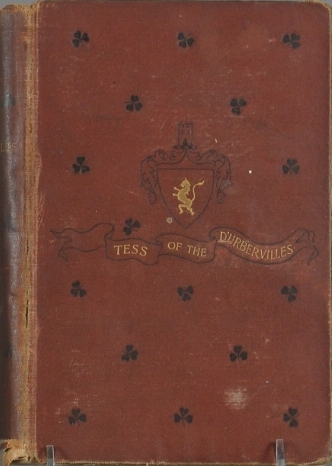
Tess of the d'Urbervilles


Having recently read Wuthering Heights, which is often heralded as a passionate triumph, and being somewhat disappointed, I was worried the same would happen when reading Tess of the d'Urbervilles by Thomas Hardy. However, Tess of the d'Urbervilles was brilliant. It was full of tragedy, tension and beautiful, descriptive writing. Even though there are many events that are deeply tragic and terrible, they are subtly and sensitively written.

Spoiler Warning!

Tess is a brilliant, virtuous character, the archetype of rural innocence. Although she may be seen as too-good-to-be-true and therefore an unrealistic portrayal of femininity, I think the way Hardy portrays her allows her to be both believable and loveable. Despite her constant pursuit of honesty and integrity, she constantly has to struggle against the evils of this world until her simple soul is finally and desperately crushed. You know from the offset she wasn't made for this world.

Alec d'Urberville may be the obvious villain of the story but some find Angel Clare a more detestable figure. It could be that Angel Clare was, at first, a potential source of happiness and hope for the wronged Tess, but he desperately lets her down. Also, Angel Clare never really has to suffer for his actions; Alec d'Urverville gets his comeuppance but Angel's failure not only remains unpunished but he has the chance to live a life of love and happiness: one that Tess couldn't. I feel, however, that Angel redeems himself at the end for enabling Tess to have a few days of true happiness and for not abandoning her when he could have done.

Hardy's writing style is really beautiful. He constantly forewarns the reader of upcoming tragedies, which adds to the horror of watching Tess innocently trying to conduct her life. Whilst she is at Talbothays Dairy, the reader has a conflicting sense of joy and hope at Tess's young love and the ominous feeling that it isn't going to last, which of course, it doesn't. When the forewarned tragedy does strike, it is never overwrought or melodramatic. Even outpouring of emotion seems justified by poor Tess, as her fate is just horrific. One example of a brilliantly crafted sentence that states the sorrow with superb simplicity is when Tess's child dies:
"So passed away Sorrow the Undesired—that intrusive creature, that bastard gift of shameless Nature, who respects not the social law; a waif to whom eternal Time had been a matter of days merely, who new not that such things as years and centuries ever were; to whom the cottage interior was the universe, the week's weather climate, new-born babyhood human existence, and the instinct to suck human knowledge."
The whole section of the baby's baptism and death is just brilliant.

The ending, although good, was not what I expected. I always knew how Tess's life played out, but the section is Sandbourne was not how I imagined it. It was perhaps appropriate that Tess was taken away from her usual rural setting towards the end to show how she had no place in this increasingly urban and industrialised world. I was a bit disappointed that Tess had abandoned her sense of morality, but I suppose that was the point. I realised my expectations and hopes that Tess could yet have a life of purity and innocence were foolish; something Tess herself had already become resigned to.

Summary
Favourite character: Tess, obviously.
Least favourite character(s): Tess's parents, John and Joan Durbeyfield. They are constant sources of bad ideas and poor advice, being utterly useless in protecting Tess or providing her with any good prospects.
Favourite section: The baptism and death of sorrow.
Least favourite bit: Tess in Sandbourne.
Critical issues: Tess is too good and pure, something feminists may have a problem with; all the men are idiots; the issue of class and wealth.

Tuesday, 28 June 2011

Wuthering Heights

Title page of original edition of Wuthering He...Image via Wikipedia

I began to read Wuthering Heights, by Emily Bronte, in the hope it would live up to the Kate Bush song. Unfortunately it didn't. I suppose Kate Bush is hard to live up to and the book wasn't entirely bad.

Wuthering Heights is about a vindictive lover, Heathcliff, that mourns relentlessly over Catherine Earnshaw. Heathcliff is a typical "Byronic hero", brooding and tortured by his own passions. After a lot of illness, swooning, sobbing and negligence on the part of Nelly Dean, the story comes to a rather satisfying end.

So what I liked:
  • The frame narrative: Wuthering Heights is set in a remote location on the Yorkshire Moors. The frame narrative is quite deep: Lockwood, our somewhat irritating narrator, is retelling a story as told to him by the surprisingly articulate housemaid, Nelly Dean. This distances the reader from the narrative, giving us a sense of this remote story that unfolds.
  • The ending: the ending really redeems the book. It saves two of the main characters from being petulant idiots and gives a sense of hope at the end of this cycle of misery.
What I didn't like:
  • How melodramatic it was. The blurb says it's "one of the most passionate and heartfelt novels ever written." I read "one of the most over-the-top and sappy novels ever written." The people swoon, have an attack of the spleen or get ill too easily.
  • The characters: they're all irritating to some degree. Nelly Dean is opinionated; Heathcliff, heartless; and Lockwood and Linton need to grow a spine.
  • Its repetitiveness: they fall in love, it doesn't work out, someone becomes a raging alcoholic, someone gets ill, they fall in love, it doesn't work out, raging alcoholic, get ill, fall in love...oh, it works out this time. It just seems like the same plot over and over again. Except the end that does do a bit of a switch and bait.

I'm glad I read it. The imagery is and descriptive writing is powerful, and Bronte uses some nice literary devices (e.g. the frame narrative).

Tuesday, 29 June 2010

Book #9: The Père-Lachaise Mystery

My ninth book done and dusted. And I'm only four books behind. Four? Four‽ If you're curious as to what that strange symbol is, it's a little used piece of typography known as the interrobang. I think I'll write a post about it. Yes, I'll get onto that.

The Père-Lachaise Mystery by Claude Izner is a murder mystery that follows a bookkeeper, Victor Legris, through the streets of nineteenth century Paris, trying to find the whereabouts of his former lover Odette de Valois. When I say we follow Victor Legris, that is not entirely true. And when I say through Paris, that's not entirely true either.

The story begins in Columbia, with a dying man being suspiciously buried in a remote village and then we sweep to the Père-Lachaise cemetry where a widow is visiting the tomb of her late husband. From here on in we explore the lives of the maid of Odette de Valois in her frantic response to the disappearance of her mistress; a strange old man; and Legris' employee at the book shop.

Throughout most of the novel you know more than Legris, yet obviously he still gets to the conclusion before you do, despite the fact that there is a very limited cast of suspects. As a matter of fact, you are never really presented with a bill of suspects like you do in other mysteries, such as by Agatha Christie. The distinction between who is a suspect and who is just an extra to place the novel in a dark, bleak Paris is never clear. I suppose that could be seen as a clever aspect of the novel, disarming the reader into not reaching the solution. I see it as annoying. I expect that is because I found the whole narrative style irriating. You spent too much time trying to work out who you were now following (Was it the nervous servant girl? Was it the guy with the dead cats?), and where abouts you were heading. They do provide a map at the front of the book, but that isn't really any help, I'd keep losing my page and then I'd not finish the book.

The book was quite feminine. Although it says it is by Claude Izner, it lies. It is infact by two sisters, Liliane Korb and Laurence Lefèvre and it shows. It gets a bit Mills and Boon in some places and Victor Legris is obviously their fantasy man. Korb and Lefèvre are also booksellers, just like Legris, and they present an idealistic idea of what it was to be one.

If you are into slushy romances and want to read a murder mystery this is probably for you. However, I'm not a slushy romance kind of guy. You can make as many aspersions about being insecure in my sexuality as you want, but it is not going to change the fact, I don't like romances.

There is a series of Victor Legris mysteries (I think this may be the second).

Monday, 31 May 2010

Book #8: Great Expectations

Now, there's a book. It took a long, long, long time to read. But it was worth it. Everyone of the four hundred and sixty odd pages contained fantastic descriptions of its people and places. You believed in the homely forge, the misty marshes, the decrepit Satis House and the dismal London. Pip, the main character, was earnest but flawed; Miss Havisham was awful and pitiful, and the change in Wemmick from when at work to when at home was always convincing.

However, somewhat troubling was the treatment of women in the novel. There is an array of women that are ghastly, abusive or just annoying. You have the cruel Miss Havisham; the sociopath, Estella; the abusive Mrs Joe Gargery; the annoying Mrs Pocket; the murderous Molly; and the various cousins of Miss Havisham who are only after her wealth. The only positive female characters are Biddy and Clara. Biddy is perhaps a little too good, and Clara only appears a few times in the book. Even the convicts are treated with a bit more respect.

Despite this, it is still a fantastic read. It sweeps through lots of themes (identity, love, revenge,
crime, money, class, etc.), but does so in a way that is never trite or hackneyed.

Favourite character: Mmm, either Miss Havisham as an enduring literary construction or Joe.
Most memberable moment: Miss Havisham's end
Best line: 'My sister, Mrs Joe, with black hair and eyes, had such a prevailing redness of skin that I sometimes used to wonder whether it was possible she washed herself with a nutmeg-grater instead of soap.'

Sunday, 18 April 2010

Book #7: Between the Assassinations

A lot of reviews of Between the Assassinations, by Aravind Adiga, harp on about how it isn't really a novel, but more a collection of short stories. Now, I could go on for ages about the problems of genre, but I wont. Between the Assassinations is not, it has to be admitted, a conventional narrative that follows the adventures of certain individuals, but rather narratives that centre around the city of Kittur, detailing the problems of class, political corruption and the political milieu. Call it a collection of short stories, call it a novel. Really, it doesn't matter.

Adiga portrays different aspects of Indian life—including the caste system, politics, religion, and poverty—with amazing clarity. We have the half Hoyka, half Brahmin school boy who explodes a bomb in his chemistry class, a Muslim boy who insists that he does 'no hanky-panky', and a Communist that realises that he has wasted his life. Adiga flows through these narratives exposing the worst and best aspects of human life.

The narratives all revolve around the beautifully realised city of Kittur, and themes of inequality, corruption, and identity weave in and out of them like a cyclist between automated rickshaws on a busy Umbrella Street.


Book #6: Hector and the Search for Happiness


On my way to the airport I realised that I had neglected to bring any reading material for the journey. So we wound up looking in WH Smith on customs side for cheap reads. I ended up buying Hector and the Search for Happiness.

The book is written in a very simplistic way, like that of a children's book, which lends it a sense of naivety and exploration. The story is a simple premise as well. There is a psychiatrist, Hector, who, noticing all the unexplainable unhappiness in his seemingly well-to-do patients, goes on a round-the-world trip to find the rules of happiness.

Here we go to China, some troubled African country and a wealthy country, presumably the USA. We meet a variety of characters, from prostitutes, wealthy bankers, professors, drug barons and fortune tellers. He finds 23 lessons of happiness (well, 24 if you count the one he crossed out), and shares them with a Einstein-esque expert in Happiness Studies.

The main things I've learnt is that if you want to be irresistible to women, dress like a psychiatrist. If that means having little glasses and a little mustache (like in Hector' case), then so be it. Hector's dabbling in misogyny (the crossed out lesson 18) is not the only disappointing thing in the book.

Like a psychiatrist, the books fails to condemn anything. War-torn nations, affairs, drug dealing, prostitution, governmental corruption, economic exploitation and the criminal underground are all found in this book and are only dealt in terms of whether it makes people happy or not. Despite this, it does not make patronising assumptions that if you are poor then you are not happy, in fact it does quite the reverse.

The wisest lesson in this book that the biggest mistake is to make happiness your goal, because once you do that, you will find it hard to get it.

It is a simple and enjoyable book, and it is not one that is meant to be thought to hard about (although I can't help it, I'm an English graduate after all).

Sunday, 21 February 2010

Book #5: Pride and Prejudice and Zombies

First things first. I've been slack. But I knew it would happen, hence why I am reading 26 books this year and not 52. If I was to read book after book I would be able to do it, because I generally read a book in a week. However, I knew I would get distracted and not be able to sustain chain-reading habits. I am still ahead, though. I should be starting my 5th book on 26th February (according to the little spreadsheet I've just made), and I've nearly finished my 6th, and it's only the 21st.

So, to the review. I like Pride and Prejudice and Zombies. It doesn't pretend to be a literary gem and is just plain fun. I haven't actually read Pride and Prejudice but I'm acquainted with Jane Austen (we met in a bar once). It follows the general Austen plot arc: woman needs a man, woman finds a man, a lot of unreasonable procrastination goes on, woman gets man, happy ending. But this version adds an element of adventure into it: woman doesn't really want man, she is a warrior after all; women kicks zombie butt; woman falls in love with man (but doesn't realise it); she kicks zombie butt; she realises it; she kicks man's aunt's butt; they fall in love and both kick zombie butt.

In other words, I liked it. It was nice that the heroine didn't just spend her time looking pretty and making witty remarks but could also work a ninja throwing star.

I'm currently reading Velvet Elvis, by Rob Bell, which I will probably review in my other blog. Because variety is the spice of life, people.


Sunday, 24 January 2010

Book #4: To Kill a Mockingbird

Harper Lee's To Kill a Mockingbird was voted the book to read before you die by British Librarians, beating the Bible to top place. I don't quite agree with that order, but it should definitely be in the top three. It is such a beautiful gem of a book.


It deals with such deep issues—racial inequality, class, rape, justice—but from the view-point of a 10 year old child (well, the narrative voice is clever and complicated). Harper Lee does this to inject innocence and humour into otherwise appalling situations.

Interestingly, To Kill a Mockingbird has seen its fair share of controversy. When it began to be taught in schools, parents asked for it to banned, because most were apparently horrified by the idea that a white girl could be attracted to a black man. However, the book has later been said not to be as critical of racism as it should be, resulting in a further call for it to be banned from teaching syllabuses. Admittedly, the word 'Nigger' is used 48 times in the book, but you always get the feeling it is not used as a derogatory term. Sometimes the best way to remove a defamatory word's power is to claim it for a use that is not; just as the LGBT movement has for the word queer, and some feminists have tried for the 'C' word. Also, the book leaves no doubt as to who you were meant to be supporting.

One more note: Pullman, this is an example of what it is to do accents properly.

So, read it before you die. If you don't do it for me, do it for the librarians.


Monday, 18 January 2010

Book 2#: Brighton Rock

Having read this book I feel some mixed emotions, two being relief and defeat. For years I've avoiding reading Brighton Rock by Graham Greene. It was a subtle act of rebellion, as my dad is a huge Greene fan, Brighton Rock in particular. For most my life I knew, as well as Hale did, that before he had been in Brighton three hours, that they meant to murder him. Don't worry, that isn't a spoiler, it's the first line. But, finally, I've read it.

And what did I think? I was good. First, because it was one of those dot dot dot endings I liked. It was one of those 'what did he mean by that?' endings. It is a brilliant ending, and I'm going to share it with you because it gives little away: "She walked rapidly in the thin June sunlight towards the worst horror of all." When you thought it wasn't going to get any worse, when you thought it was all over, Greene, at the very last moment, makes you realise you were very much wrong. What was that worst horror of all? My theory was that it was a gramophone record.

There was a really strong sense of different moralities, though most of the characters had abandoned them long ago. There was the dubious and subjective Right and Wrong of Ida Arnold and the Good and Evil (mostly evil) of the Romans (Catholics).

If you don't want a lesson on human depravity, read it just because it is a good thriller.


Sunday, 3 January 2010

Book #1: Looking for Alaska

It is sixty-six and a half hours into 2010 and I have already finished the first book of my 2010 challenge. You’d think as an English graduate I’d find the reviewing part of it easy. But, actually it’s quite difficult to take a step back—not to give a Freudian/Marxist/feminist account of the story, not write an essay—and write plainly what I thought. Discuss.

Did you see what I did there? I turned it into an essay question. That’s the way we roll here, kids. Anyway, back to the book. It was Looking for Alaska by John Green. Well, I liked the characters because (1) I could relate to them. Miles, the protagonist was a geek: I’m a geek; (2) they all had their flaws. Miles was irritating: I’m irritating; and (3) I can’t think of a 3 right now, but 1 and 2 were good. I didn’t like them because, sometimes, they were too irritating. But that’s okay, because if the characters could admit when they didn’t like each other, so can I.

One impression I was left with though was that for a book so obsessed with last words it ended on a rather bum note. It was more of a dot dot dot, than anything else. And not one of those good dot dot dots, that leaves you thinking, “What? How can you do that, you crumby author? How could you leave us with so many unanswered questions?” Those are the good type of dot dot dot endings. No, this was like one of those conversations that you have where everyone talking gradually looses interest and you end in an awkward silence. And then you feel you have to clear your throat, or say, "Sooo..."

However, I loved the philosophical feel to the book. I loved the aforementioned last words that filled the narrative like dead on a battle field. I loved that it was a book written by a nerd, about a nerd and, probably, for nerds. One character learnt all the capitals of the countries in the world. I mean, my brother did that. It is one of those books that you could unashamedly talk in terms of feminism, Freud, Marxism, and all that jazz, because it seeped with references to different schools of thought, especially feminism. However I won’t do that, because that’s dull.

So it was a nice, familiar (read: predictable), and laid back start to my 2010 book marathon. I would say: read it, it won't kill you.